Classic Napoleon Cake (Mille-Feuille)
Dozens of paper-thin, flaky pastry layers soaked overnight in silky vanilla custard - this is the Napoleon cake from every Ukrainian grandmother's recipe box, always made the day before and always worth the wait.
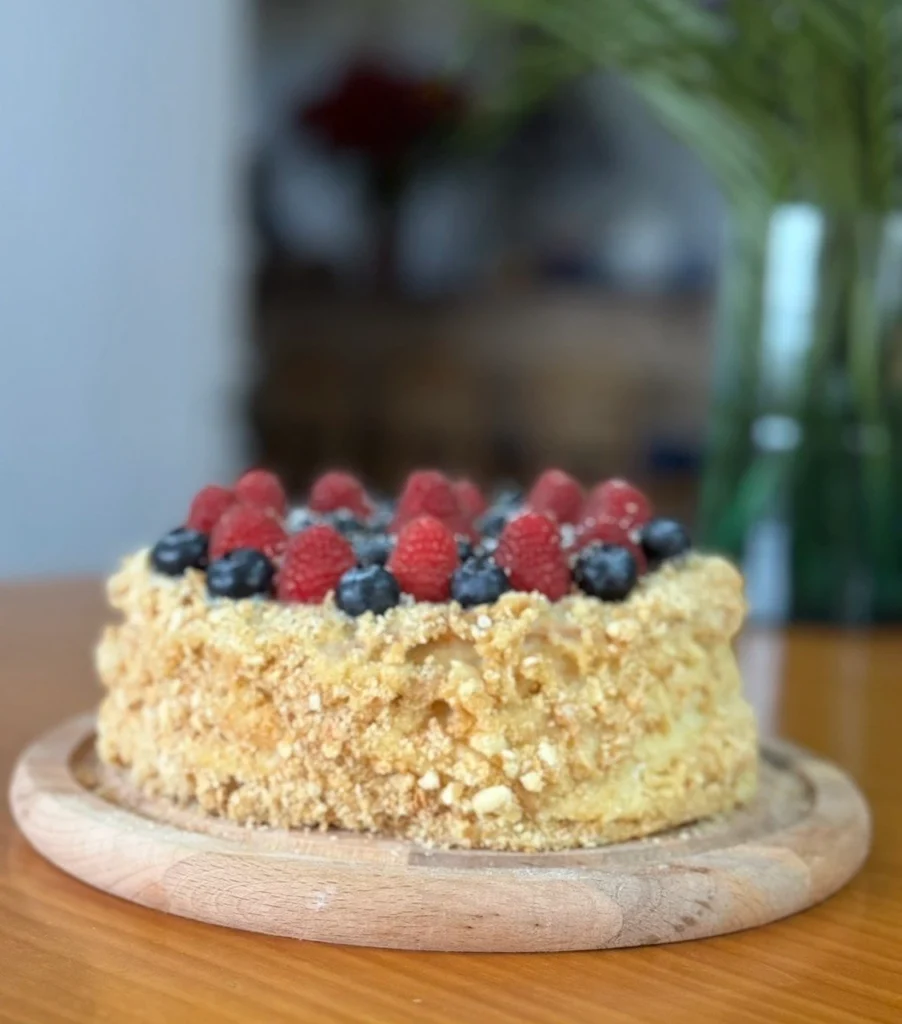
Napoleon cake is not something you make on a Tuesday afternoon when you want dessert by 6pm. It is an overnight project – a series of thin, crackling pastry layers that spend the night absorbing a cooked vanilla custard until they surrender completely and become something impossibly tender. The result is nothing like the French mille-feuille it shares a name with, and that is entirely the point.
The dough is made by hand, with cold butter rubbed into flour the old-fashioned way, then brought together with egg, sour cream, and a little vinegar. The vinegar relaxes the gluten just enough to make rolling easier without turning the dough tough – one of those small details that seems optional until you skip it. Each portion gets rolled as thin as you can manage, almost translucent, and baked separately on a hot tray until just golden.
The custard is a cooked one, made on the stove. It takes patience and a steady hand with the whisk, but it is not difficult. The step that trips people up most often is adding the hot milk too quickly to the egg mixture, which scrambles the eggs before you have even started. Go slowly for the first pour, keep whisking, and it will be fine. The finished custard needs to cool completely before you beat in the butter – warm custard will melt the butter instead of combining with it, and you will end up with something soupy rather than silky.
Ten layers sounds like a lot, and it is – but each one bakes in about five minutes, and the rhythm becomes almost meditative by layer four. The trimmings from shaping the rounds get baked alongside and then crushed into crumbs, which coat the outside of the assembled cake. This is the detail that makes a Napoleon look finished and proper rather than just stacked.
The most common mistake with this cake is not letting it rest long enough. Eight hours is the minimum; overnight is correct. Cutting into it after two hours gives you crunchy, separate layers and a cream that has not bonded with anything – edible, but disappointing. Overnight, the custard soaks into the pastry and the whole thing becomes cohesive, soft, and deeply flavored.
A few swaps worth knowing: full-fat plain yogurt works in the dough if you do not have sour cream. For the custard, some versions use whole eggs instead of just yolks – slightly less rich, but it works. And while raspberries and blueberries are a beautiful finish, the cake is equally complete with just the crumb coating if berries are out of season.
If you love a cake that is all about patience and layering, try Tres Leches Cake – it works on the same overnight principle. Or Pastel de Nata for another recipe with that same layered, custard logic.
Ingredients for Classic Napoleon Cake (Mille-Feuille)
- For the dough:
- 3 cups (375 g) all-purpose flour, plus more for rolling
- 200 g cold unsalted butter, cut into small cubes
- 1 large egg
- 1/2 cup (120 g) full-fat sour cream
- 1/4 tsp fine salt
- 1 tsp white wine vinegar
- For the custard cream:
- 1 liter (4 cups) whole milk
- 4 large egg yolks
- 1 cup (200 g) granulated sugar
- 1/3 cup (45 g) all-purpose flour
- 2 tbsp (20 g) cornstarch
- 200 g unsalted butter, softened to room temperature
- 1 tsp vanilla extract
- For topping:
- Fresh raspberries and blueberries
How to Make Classic Napoleon Cake (Mille-Feuille)
-
1
Combine the flour and salt in a large bowl. Add the cold butter cubes and rub them into the flour with your fingertips until the mixture looks like coarse, uneven crumbs - some pea-sized pieces of butter are fine and expected.
-
2
In a small bowl, whisk together the egg, sour cream, and vinegar. Pour into the flour mixture and stir with a fork, then press and knead briefly just until a rough dough forms. Do not overwork it.
-
3
Divide the dough into 10 equal portions. Flatten each into a disc, stack them on a plate, cover with plastic wrap, and refrigerate for 30 minutes.
-
4
Preheat your oven to 400°F (200°C). Line a large baking sheet with parchment paper.
-
5
On a lightly floured surface, roll one portion of dough as thin as possible - aim for about 2 mm. Place a 22-23 cm (9-inch) plate or cake tin on top and trim the dough into a neat round. Set the trimmings aside in a bowl.
-
6
Carefully transfer the round to the lined baking sheet. Prick all over with a fork to prevent bubbling. Bake for 5-7 minutes until golden and just crisp. Transfer to a wire rack to cool. Repeat with all remaining portions.
-
7
On the final bake, add all the collected trimmings to the tray and bake them alongside the last round. Once cooled, crumble the baked trimmings into fine crumbs with your hands or a rolling pin.
-
8
While the layers cool, make the custard. In a medium bowl, whisk together the egg yolks, sugar, flour, and cornstarch until the mixture is pale, smooth, and thick.
-
9
Heat the milk in a heavy-bottomed saucepan over medium heat until it just begins to steam - do not let it boil. Pour about one-third of the hot milk into the egg mixture in a slow, thin stream, whisking constantly. This tempers the eggs. Pour everything back into the saucepan.
-
10
Cook over medium-low heat, stirring constantly with a spatula and reaching into the corners of the pan, until the custard thickens and the first bubbles appear - about 8-10 minutes. It will look lumpy at first; keep stirring and it will smooth out into a thick, glossy cream.
-
11
Remove from heat immediately. Press a sheet of plastic wrap directly onto the surface of the custard to prevent a skin forming. Let it cool completely to room temperature, about 1 hour.
-
12
Beat the softened butter with an electric mixer until light and fluffy, about 3 minutes. Add the cooled custard one large spoonful at a time, beating well after each addition, until the cream is smooth, silky, and holds its shape. Add the vanilla and mix briefly.
-
13
Place one pastry layer on your serving plate or board. Spread a generous, even layer of custard over the top - do not be shy with it. Place the next layer on top and press down very gently. Continue layering - pastry, custard, pastry, custard - until all 10 layers are used. Finish with a layer of custard on top and spread the remaining custard around the sides.
-
14
Take the crumbs and press them firmly over the top and all around the sides of the cake, coating it completely and evenly.
-
15
Refrigerate overnight, or for at least 8 hours. The layers will absorb the custard and soften into something tender and cohesive.
-
16
Just before serving, arrange fresh raspberries and blueberries across the top of the cake.
Nutrition (per serving)
- Carbs 49g · 37%
- Protein 8g · 6%
- Fat 33g · 57%
Tips & FAQ
Why does Napoleon cake need to rest overnight?
Can I use store-bought puff pastry?
My cream is not thick enough - what went wrong?
How do I get even, thin pastry layers?
How many layers should Napoleon cake have?
More Cakes
Taiwanese Souffle Castella Cake
A soft, impossibly jiggly Taiwanese castella cake made with a butter-milk base, four eggs, and a soft meringue. Baked low and slow in a water bath for a cloud-like crumb with zero dryness.
Czech Hazelnut Wafer Cake (Oplatky)
A no-bake Czech classic made with Kolonáda spa hazelnut wafers, mascarpone, dulce de leche, and walnuts. Stack, chill, and slice - the layers soften into something rich and quietly addictive.
Classic Sour Cream Pound Cake
Dense, buttery, and impossibly tender - this sour cream pound cake has a fine crumb that slices cleanly and a flavour that quietly gets better on day two.
Related searches